
What Happens to My Old Mattress During a Mattress Delivery?
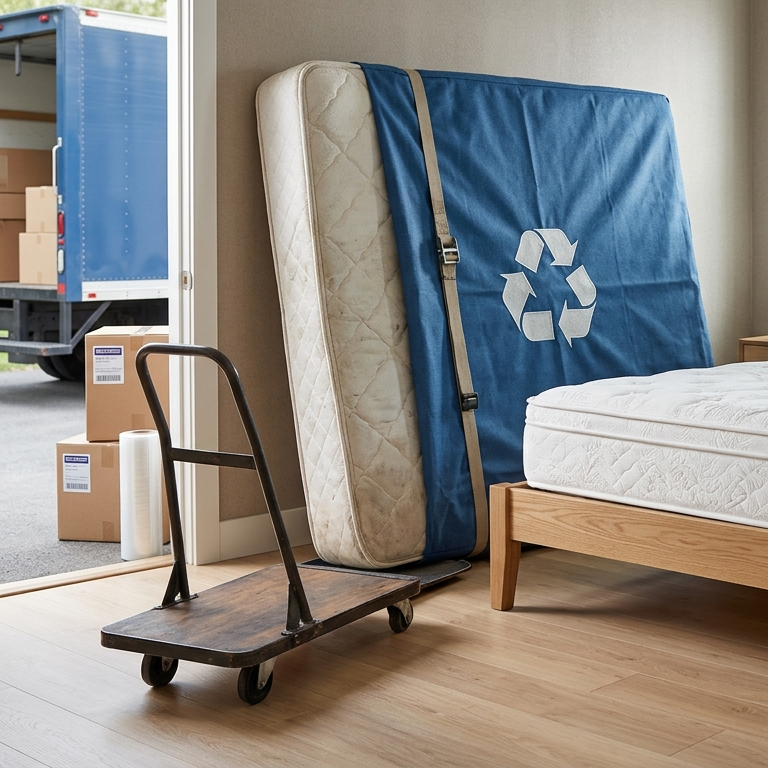
You picked the new mattress, scheduled the delivery, and cleared the calendar for the window. The part that catches people off guard is the old one. A queen mattress and its box spring do not fold up small, they do not fit in a curbside bin, and most people have no idea where the thing actually goes once it leaves the bedroom. The short version: if you arranged haul-away, the crew takes it out the same trip they bring the new one in, and what happens after that is a lot less casual than tossing it on a truck and forgetting it.
This guide walks through the removal side of a mattress delivery. It covers what the crew does at your door, where an old mattress goes, and why that path is more involved than it looks, why the mattress you slept on last night almost certainly cannot be donated, and the small amount of prep on your end that keeps the whole thing quick and clean.
What the Crew Actually Does at Your Door
A full in-home mattress delivery consists of two halves, and removal is only one of them. First comes the new mattress: the crew brings it into the room you designate, unboxes or unwraps it, and positions it on your existing frame or foundation so it is ready to use, not leaning in a hallway. For a bed-in-a-box-style order, they may cut the plastic and let the compressed foam mattress begin to expand in place.
The removal half only happens if you arranged haul-away when you booked. When it is on the order, the crew strips the old mattress off the frame and the box spring, or the foundation, too if you asked for it, and carries both out to the truck as part of the same visit. That timing is the whole convenience of it: the new bed goes in, and the old one comes out in one trip, so you are never stuck sleeping around a used mattress propped in the garage waiting for bulk pickup day.
What the crew does not do is make a judgment call on haul-away in the moment. If it was not booked, most crews are not able to load your old mattress on the spot, because it changes what goes back on the truck and where that load is headed. The removal has to be on the paperwork before the truck arrives.
Where the Old Mattress Goes, and Why It Is Not Simple
Here is where a mattress differs from almost any other thing you throw out. It is bulky, built from several materials bonded together, and resistant to crushing. A garbage compactor cannot flatten a spring unit the way it flattens a bag of trash, so the springs spread inside the truck and eat up volume. That is exactly why a mattress is treated as a problem item at the disposal end.
Think of an old mattress less like a bag of trash and more like a car battery: it is not something you can quietly slip into the regular waste stream because it contains materials that need to be handled separately. Many landfills either restrict mattresses outright or charge an added fee to take one, precisely because they take up so much airspace and are awkward to bury. So a responsible handler does not just drive to the nearest dump and heave it over the edge.
Where recycling is available, that is the better path, and a mattress is surprisingly recyclable once it is broken down. A recycler cuts it open and separates the layers: the steel springs go to scrap-metal recovery and get melted down, the foam and fiber padding are baled and reused in products like carpet underlay, and the wood frame inside a box spring is chipped for mulch or fuel. A large share of a single mattress's weight can be diverted from the landfill this way. When recycling is not reachable, proper disposal at a facility that accepts mattresses is the fallback, which is still a deliberate step, not a shortcut.
Why You Cannot Just Donate It
Almost everyone's first instinct is kinder: someone could still use this, so why not donate it. For a used mattress, the answer is hygiene, and it is close to universal. Most charities and thrift operations decline used mattresses outright, and many jurisdictions restrict the resale of used mattresses unless they have been professionally sanitized and relabeled.
The reason is what a mattress absorbs and can carry. Bed bugs are the headline worry, since they hide in seams and can survive a move, but the broader issue is sanitation: sweat, skin, dust mites, and moisture that no surface cleaning fully reaches. A charity has no practical way to certify that a used mattress is clean and pest-free, so the safe policy is to refuse it. That is why "recycle or dispose of it properly" is the honest route for a mattress that has been slept on, even one that looks fine. Resale and donation are realistic only for something still sealed or never used, which is not the mattress coming off your bed.
Prepping the Old Mattress for a Smooth Removal
The removal goes faster and cleaner when a few things are handled before the crew arrives, and it takes none of the crew's time.
Strip all the bedding first: sheets, mattress protector, and any topper come off and stay with you, since those are yours to keep or wash and are not part of the haul-away. Clear the path the crew will use from the bedroom to the front door, moving rugs, cords, floor lamps, and anything narrow enough to snag a mattress as it's angled around a corner. If you have stairs or a tight hallway turn, glance at it ahead of time so it is not a surprise at the door.
One step people skip but should not: bag the old mattress, or have it bagged, before it is carried through the house. A disposable mattress bag, the same plastic sleeve movers use, keeps decades of accumulated dust from puffing into the air on the way out and contains any pests, so nothing gets shaken loose onto a carpet or a doorway. Some services bring a bag and sleeve the mattress on site; if yours does not, a bag from a hardware or moving-supply store does the job. It is a small thing that keeps the removal from spreading a mess through the house.
Confirming Haul-Away and Who Is Handling Your Delivery
The single detail worth nailing down before delivery day is whether haul-away is actually on your order, because it is the one part that will not happen by default. It is typically a separate service, often an add-on fee arranged in advance rather than bundled into the base delivery price, and it must be confirmed ahead of time so the crew comes prepared to load and route the old mattress correctly.
It also matters who is running your delivery. A furniture or mattress retailer's delivery may or may not include removal, and the terms vary by store, so read the exact service line at checkout rather than assuming the old mattress is covered. When a dedicated delivery service handles the final-mile drop, removal is commonly offered as a named add-on you select when booking. Either way, the move is the same: check whether removal is included, and if it is not, add it before the truck is scheduled, not on the day. Confirming it in advance is what turns delivery day into a single clean swap instead of a new mattress in the bedroom and an old one you still have to figure out.
Frequently Asked Questions
When does the old mattress actually get taken out during the visit?
The haul-away happens on the same appointment as the new-mattress setup, not a separate trip on another day. In practice, the crew often brings the new mattress in and gets it positioned first, then strips and carries out the old one as they leave, so the room is never empty in between. For that to run smoothly, the crew needs two things ready: a clear path from the bedroom to the door, and the old bed already stripped and accessible, not buried under a headboard, storage bins, or a pile of laundry. If the crew has to wait while you pull sheets and clear a route, it slows the whole appointment. Confirm haul-away is on the order, then have the bed prepped before the window opens.
Is there ever a case where a used mattress can be donated?
Rarely, and the bar is high. A charity might accept a mattress that is truly unused, still in its factory seal, or only lightly used and visibly clean, for example, a guest-room mattress slept on a handful of nights. But three things usually rule it out: any sign of bed bugs, any stain at all (which a charity reads as a sanitation risk it cannot verify), and local law, since many jurisdictions bar reselling or redistributing a used mattress unless it has been professionally sanitized and relabeled. Because most beds coming off a daily-use frame fail at least one of those tests, recycling or proper disposals ends up being the honest path even when the mattress looks fine to you.
What does a mattress recycler actually recover from an old bed?
More of the mattress than most people would guess. Once it is cut open, a recycler sorts it into a handful of commodity streams: the steel innerspring and any border rods go to scrap-metal recovery and are melted down, the polyurethane foam is baled and shredded into carpet underlay (the bonded padding under wall-to-wall carpet), the wood frame inside a box spring is chipped for mulch or biomass fuel, and the cotton, felt, and fiber batting are pulled off for reuse. By weight, the majority of a single mattress can be diverted from a landfill this way. Some regions run dedicated mattress-recycling programs that fund exactly this teardown, which is part of why a responsible handler takes the mattress to a facility rather than a dumpster.
What if my old mattress might have bed bugs or is heavily soiled?
Tell the delivery service when you book, because it changes how the mattress is handled at your door. A mattress that may carry bed bugs, or one that is heavily soiled, gets bagged and sealed in a plastic mattress sleeve before it moves through the house, so nothing sheds onto your carpet, doorframes, or the crew's other stock on the way out. The crew may also handle it differently: keeping it away from clean inventory, using a dedicated bag, or routing it straight to disposal rather than a recycling line that will not accept an infested unit. Flagging it up front is not a reason for refusal; it just lets the crew come prepared instead of discovering it mid-carry.
Does a tight staircase, lift, or narrow doorway affect removal?
Yes, and those are exactly the details to flag when you book. A queen or king mattress is a large, floppy object to steer, so a narrow doorway, a sharp hallway turn, a walk-up with a tight staircase, or a small apartment lift all shape how, and how quickly, the old one comes out. Box springs are worse than the mattress here because they are rigid and cannot be bent around a corner; an oversized box spring sometimes will not clear a turn that a mattress can flex through. Telling the service about stairs, lift size, or a cramped entry ahead of time lets the crew plan the route and bring the right number of people, instead of getting a heavy old bed stuck halfway out on delivery day.
What about my old box spring or bed frame? Do those go too?
The box spring or foundation can be removed along with the mattress if you include it when you arrange haul-away, and it recycles the same way, with its wood chipped and any metal recovered. A bed frame is a separate item and is not always covered by mattress haul-away, so if you want the frame gone as well, say so when you book and confirm it is on the order. As with the mattress, none of it is a spot decision at the door: whatever you want carried out has to be listed on the removal before the truck arrives.