
How to Move a Mattress Without Damage: 8 Steps That Work
A mattress looks tough, so people treat it like one. Then it comes off the truck with a crushed corner, a torn cover, or a permanent sag, and the warranty claim gets denied because the damage happened during transport. A mattress is closer to a stretched drum skin over a rigid frame than to a cushion you can toss around. Fold or crease it and the parts inside stop lining up the way the maker intended.
Most of the ruin traces back to four moves. Bending an innerspring past its normal flex can kink or unseat the coils and the wire connectors that tie them together, and a kinked coil never springs back straight. Folding memory foam or latex forces a sharp crease into a material meant to bend only gently, and the foam can split or hold a weak line. Dragging a mattress across a floor, a threshold, or a truck bed grinds and snags the ticking and the fabric cover until it tears or pills. And letting it get damp or dirty leaves stains that soak in, and a stain is the fastest way to void the warranty, since manufacturers routinely reject any claim on a mattress showing soiling.
The good news is that none of that is hard to prevent. The protection is mostly cheap materials and a little planning before anyone lifts anything.
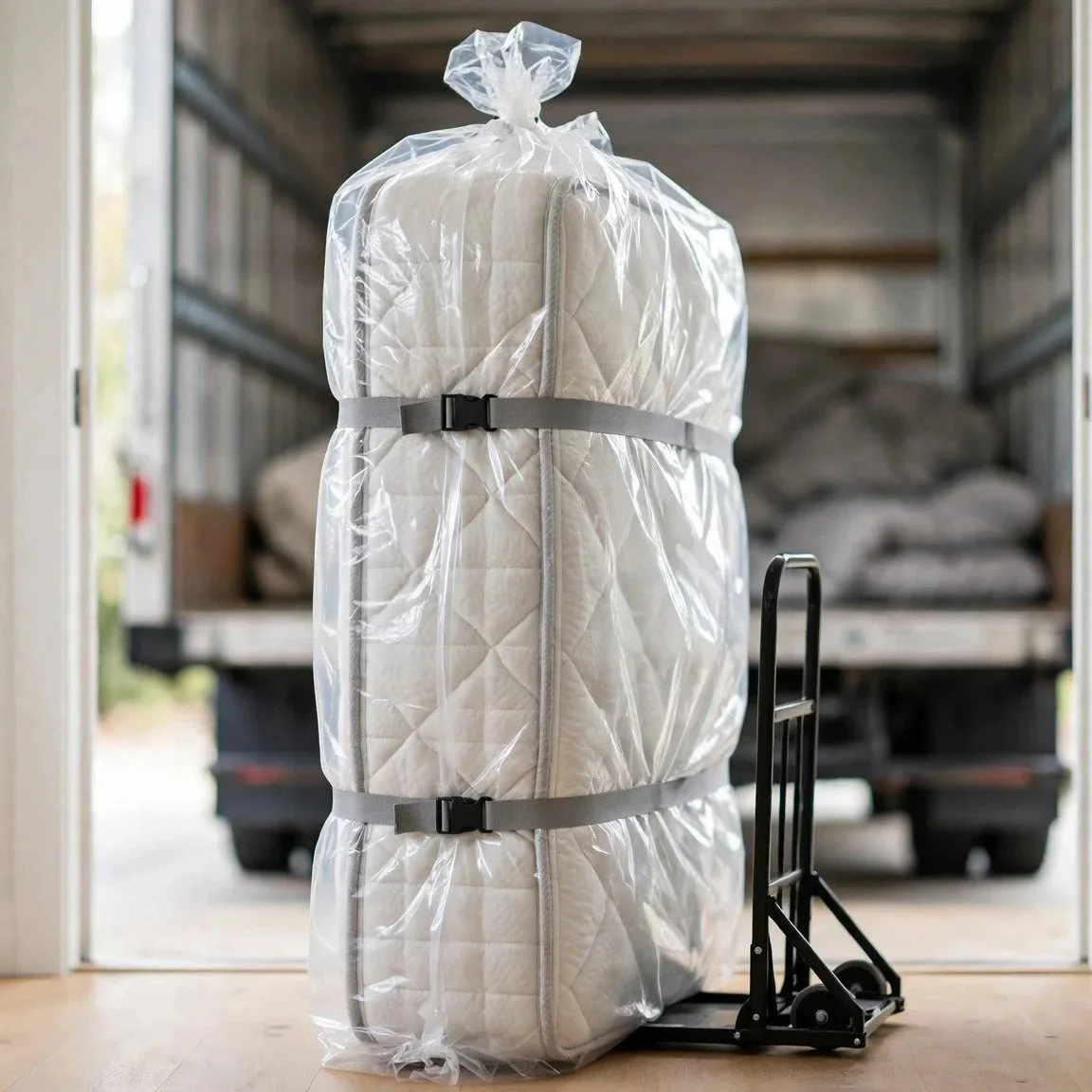
Wrap It First With A Proper Mattress Bag
Before the mattress leaves the bedroom, get it into a cover. A dedicated mattress bag is a heavy plastic sleeve sized by mattress dimension (twin through king), and it does three jobs at once: it keeps out dirt and moisture, it gives you a smoother surface to slide against a wall or dolly, and it keeps the tag and the clean surface intact for any future warranty claim.
Pick the right protection for the trip: A basic disposable poly bag is fine for a short local move. For a longer haul, or if the mattress will sit in storage, a thicker reusable bag with a zipper holds up better and reseals if you need to open it. Tape the open end shut with packing tape so road dust and grit cannot work their way in.
Do not skip this on a hot or wet day: Heat alone will not hurt a wrapped mattress, but an unwrapped one in an open truck picks up road grime, and a surprise rain or high humidity soaks the ticking. The bag makes the mattress weather-neutral, so the same wrap works in a dry month or a wet one.
Keep It Flat Or On Its Side, Never Folded
This is the rule that saves the mattress. Carry and store it flat or standing on one long edge. Never fold it in half, and never let it bend under its own weight while two people carry it by the ends.
Innersprings are the least forgiving: The coil layer inside is a connected grid, and folding it forces the coils and their connecting wires past their designed range. Standing an innerspring on its side is fine for short carries because the coils still run the way they were built to. Folding is what does the harm.
Foam and hybrid mattresses bend, but only gently: A thick all-foam or latex mattress can flex slightly, which is why some ship rolled from the factory in a machine-controlled roll. That is not the same as a person creasing it around a doorframe. A hard fold can crack the foam or leave a lasting soft line, so treat foam as no-fold too once it is expanded.
The coil grid behaves like a wire fence panel: lean it, stand it, carry it upright all you like, but crease it once and the bend stays.
Secure It So It Cannot Flop Or Slide
A mattress is floppy, and a floppy load is a hurt-back load. Before you move it any distance, give it some control.
Tie it into a manageable shape: Two or three moving straps or lengths of soft rope around the width keep the mattress from sagging and folding in the middle while you carry it. Do not cinch so hard that you crease it; snug is enough to hold its shape. Some movers slip the wrapped mattress between two sheets of cardboard on the flat faces for extra rigidity through tight spots.
Mind the handles: Any sewn-on side handles on a mattress are for adjusting position on the bed, not for carrying its full weight. Pull hard on them, and they can rip out of the seam. Support the whole mattress from underneath instead.
Use A Dolly Or A Helper, Because A King Is A Two-Person Job
Roll it when you can: An appliance dolly or a flat furniture dolly under the wrapped mattress does most of the work and spares your grip and back. Strap the mattress to the dolly so it cannot tip.
Carry it with a plan, not blind: On stairs, the person walking backward should never move blind, so the downhill or lead person calls out each step. A mattress that blocks your view of your own feet is how people fall. Slow, announced steps beat speed every time.
WARNING: A queen typically runs 120 to 160 pounds and a king can top 130 to 180, and both are too wide for one person to see past or control on stairs, so treat them as a team lift. On stairs, the person walking backward should never move blind; a mattress that blocks your view of your own feet is how people fall.
Protect Corners And Edges Through Doorways And Stairs
Damage happens at the pinch points, the doorframes, stair corners, and railings where the mattress gets forced through a gap narrower than it is.
Measure the tight spots first: Check the narrowest doorway and any stairwell turn against the mattress width before you start. Standing the mattress on its long edge makes it narrower to thread through a door, and angling it diagonally often clears a turn that a flat carry cannot.
Pad the contact points: A folded moving blanket taped over an exposed corner, or over a metal doorstrike and stair nosing, keeps the ticking from snagging and tearing at the exact spots it tends to catch. Go slow at each threshold; the tear happens in the one second someone shoves.
Load It Flat In The Truck And Tie It Down
How the mattress rides is as important as how you carry it. The goal is flat, dry, and firmly secured so it cannot shift or lift in transit.
Lay it flat against a wall of the cargo area: Flat on the floor or flat against a side wall of a box truck keeps the whole mattress supported. If space forces it upright on its edge, brace it with boxes or furniture so it cannot slide down into a fold.
Never bend it over a car roof or trunk: A mattress arched over a sedan roof and held by rope through the windows is bent the entire drive, which is exactly the crease you spent all this effort avoiding, and it can catch wind and lift dangerously at speed. If a truck or van is not an option, that is the point to call a delivery service rather than improvise.
Tie it down so it cannot fly up: Ratchet straps or rope over the flat mattress, anchored to the truck's tie points, keep it from sliding or catching air. A loose mattress in an open bed can lift like a sail and come out on the highway. Cinch it snug and flat, not folded.
Keep It Dry From Start To Finish
Moisture is a slow, quiet way to lose a mattress. A damp mattress does not just feel wet; trapped moisture in foam or a coil layer can grow mildew and leave odor and staining that no cleaning fully removes, and again, any visible stain typically voids the warranty.
Wrap before it goes outside, unwrap after it is inside: The mattress bag is the whole defense here. Keep it sealed from the bedroom to the truck to the new room, in dry weather or wet, and only open it once the mattress is indoors at the destination.
Watch the truck floor: A wet truck bed or a puddle on a ramp will wick up into an unprotected bottom edge. The bag handles this, but set the mattress on a clean, dry surface at every stop rather than trusting the wrap alone.
Let Memory Foam Rest Before You Sleep On It
The last step happens after the move. Lay the memory foam flat on the bed frame in the new room and give it several hours, ideally a full day, before sleeping on it. The foam relaxes back to its rated thickness and firmness once the compression comes off, and rushing it can leave you sleeping on a temporarily uneven surface.
For a full bedroom set, an adjustable base, or anything moving between floors, a trained two-person crew with the right dolly and straps removes the guesswork and keeps the warranty-critical surfaces clean and uncreased the whole way.
FAQs
Can I move a mattress on its side without hurting it?
Yes, standing a mattress on its long edge is safe for the carry itself, including for innersprings, because the coils still run in their built orientation. The catch is what happens next: leaving any mattress standing upright against a wall for weeks can let the springs or foam settle unevenly toward the bottom, so store it flat and only keep it on its side during the actual move.
Does moving a mattress void the warranty?
The move itself does not, but the damage it can cause will. Manufacturers routinely deny claims on mattresses with any stain, a torn or removed law tag, or a visible sag, and they treat those as owner-caused, not defects. Keeping the mattress bagged, dry, and uncreased is what preserves the claim, and photographing the mattress clean before the move gives you dated proof of its pre-move condition.
What size truck do I need for a king mattress?
A king mattress is about 76 inches wide and 80 long, so it lays flat in any box truck 10 feet or longer and stands flat against the wall of most cargo vans. The dimension that trips people up is not length but the door opening and the interior height, so measure the cargo door before renting, since a mattress that fits inside can still jam at a low or narrow loading door.
How do I move a mattress by myself?
For a twin or full, stand it on its edge, wrap it, and walk it onto a dolly rather than carrying it. Solo-moving a queen or king is not advised because you cannot see past it or control both ends on stairs, but if you have no helper, a wall-hugging technique, keeping one long edge braced against a hallway wall as you slide it, gives you a second point of support the whole way.
Should I remove the mattress cover or topper before moving?
Take off any removable topper, mattress protector, and bedding first and bag them separately, since a loose topper slides and bunches under the straps and can crease. Leave the mattress's own sewn-in cover, the ticking, in place; it is part of the mattress and is not meant to come off, and pulling at it can tear the seams.
Is it worth paying a delivery crew instead of moving it myself?
For a single wrapped mattress and a short move, most people handle it fine with one helper and a dolly. The math changes with a full bedroom set, a flight of stairs, tight interior turns, or a high-value mattress where a denied warranty claim would cost hundreds, since a trained crew carries insurance and the right equipment. Fees are usually quoted by item count and stair flights, so ask for the piece count when you request a price.