
Climate-Controlled vs. Standard Storage: What Decides It
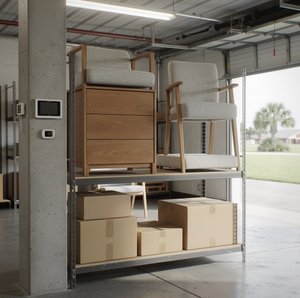
Not every pallet of business inventory needs the same kind of space. Some materials hold their shape and finish through ordinary swings in temperature and humidity; others can soften, swell, or crack when conditions drift outside a narrow range and stay there. Climate-controlled storage exists to keep that range narrow year-round. Standard storage doesn't try to hold anything steady beyond four walls and a roof. Sorting inventory into the two comes down to what each item is made of and how long it will sit before it moves again. Sorted by inventory type, the storage each one needs looks like this:
| Inventory Type | Storage It Needs | Why |
|---|---|---|
| Upholstered furniture | Climate-controlled | Foam and fabric absorb humidity, and glue in the frame can soften under heat |
| Wood and veneer pieces | Climate-controlled | Adhesive bonds and veneer layers respond to heat and moisture swings |
| Leather | Climate-controlled | Natural oils dry out faster in heat, which stiffens and can crack the surface |
| Mattresses | Climate-controlled | Foam and quilted layers hold moisture and lose resilience under repeated heat cycling |
| Electronics | Climate-controlled | Humidity swings can drive condensation on internal components |
| Boxed hardgoods (metal or outdoor furniture) | Standard can suffice | Metal and outdoor-rated finishes tolerate ordinary swings; cushions and wood parts may not |
| Artwork and mirrors | Climate-controlled | Canvas, backing, and mirror adhesive react to humidity changes |
What Climate Control Holds Steady
Climate-controlled space regulates two things at once: temperature and humidity. That distinction matters because a space that only manages heat can still let moisture drift in with the outside air, and moisture alone can cause real damage to wood, fabric, and finishes, even when the temperature reading looks fine. A properly climate-controlled warehouse holds both within a set range through every season, so inventory sitting there in August isn't exposed to different conditions than the same inventory sitting there in February. That consistency is the entire point: it removes the variable that standard storage leaves open.
Standard storage still has walls, a roof, and locked access, and none of that is worthless. It keeps inventory dry from rain and out of direct weather, and it protects against theft the same way any secured space does. What it doesn't do is hold the air inside to any particular range. A standard space can run close to the outside air temperature and humidity levels, which is fine for inventory that doesn't react to either, but a real gap for inventory that does.
How Heat and Humidity Swings Damage Stock
Heat and humidity damage doesn't always show up right away. Glue joints in a wood frame can soften under sustained heat, and veneer bonded with a thin adhesive layer can lift at the edges once that bond weakens. Leather can stiffen and crack as its natural oils dry out faster than they would in stable conditions. Fabric upholstery and foam cushioning can lose shape and develop odors when humidity swings leave moisture trapped inside a piece rather than allowing it to dissipate. Humidity swings can also invite mold or mildew on fabric, packaging, and cardboard, which may appear as a smell or a stain once the piece is unboxed. Exposed metal parts, including hardware and connector pins on electronics, can pick up light corrosion when repeated humidity swings bring condensation and drying cycles one after another, even with no standing water anywhere near the piece. None of this is limited to inventory sitting still: a piece can pick up the same kind of heat exposure while it's still moving toward a warehouse, which is a separate risk from how it's held once it arrives.
Inventory That Tolerates Standard Storage
Not every category needs the narrower range. Boxed hardgoods with sealed metal components and outdoor furniture built to handle sun and temperature swings by design can hold up well in standard space. The same goes for anything already built to spend time outside a controlled environment before it reaches a customer. What determines it is whether the specific item changes when the surrounding air does.
The Business Side: Turnover, Dwell Time, and Damage Claims
How long inventory sits is a separate factor from what it's made of, and it decides the call for a gray-area item. Fast-turning stock that clears a warehouse in days carries less exposure risk than the same category of inventory held for months, simply because there's less time for heat or humidity cycling to add up. That's worth weighing for items that fall into a gray area: durable enough to survive a short hold in standard storage, but risky if a shipment gets delayed and that hold stretches out. A gray-area piece expected to sit for a week is a different call in a stretch of extreme summer heat, when that week is enough exposure to matter, than in a mild summer, when the same week in standard space leaves little to worry about.
A shipment that was supposed to sit for a week but instead sits for six weeks changes the math on which storage tier makes sense, and a business planning around a fast-turnover schedule doesn't always account for what happens when that schedule slips. Building in some margin for delay, rather than assuming every item moves on its original timeline, makes it less likely that a gray-area piece spends an unplanned month in space meant for a short hold.
A piece that arrived with a noted damage exception remains in the same controlled hold while its claim is processed by the carrier. Tagging a gray-area item with the date it entered the warehouse, not just the project or order it belongs to, makes it possible to flag anything that has sat past its planned hold before the record gets buried under newer inventory.
What to Ask a Warehouse Before You Commit Inventory
Before committing inventory to any facility, ask what happens at receiving: whether items get inspected and logged the moment they arrive, or stacked and left until someone needs them. The same receiving and inspection steps sit behind designer warehousing, and they work the same way for any business inventory moving through a warehouse.
It also helps to ask how the warehouse separates stock categories once they're inside, rather than assuming a climate-controlled label applies evenly across the whole building. Some facilities run one zoned room for sensitive inventory and leave the rest of the floor at standard conditions, while others hold everything in the same controlled space regardless of what it is. Neither approach is automatically wrong, but knowing which one you're getting changes how confident you can be that a specific pallet is protected, rather than just sharing a building with space that is. It's worth asking whether the facility also runs pest monitoring near boxed inventory, since cardboard and packaging can harbor pests, and a stack of damaged cartons is its own kind of loss.
Look at what the bottom layer of stock rests on. Pallets or racking keep goods off bare concrete, and a slab can wick ground moisture into the lowest boxes over a long hold, even in a cooled room.
Frequently Asked Questions
Does climate-controlled storage continue to work during a power outage?
Only if the facility has backup power for its HVAC equipment. Without it, a room starts drifting out of range once cooling and humidity control stop, so ask whether backup power covers the controlled zone and whether an alarm alerts staff the moment the equipment goes down.
What happens to returned inventory before it goes back into climate-controlled space?
It should be re-inspected before it goes back on the shelf. A returned piece may have picked up moisture, a scuff, or a loose joint since it first left the warehouse, so ask whether returns are checked against their original condition before they go back into climate-controlled space.
Does it matter how boxes are stacked inside a climate-controlled room?
Yes. Cartons pushed flush against a wall lose airflow, and stock stacked without any gap between boxes can leave pockets of still air around the inventory that the room's readings don't show. Ask whether cartons go in with room off the walls and between stacks, since a facility can qualify as climate-controlled overall without giving every carton the same airflow.
How do warehouses know a climate-controlled space is holding steady?
A facility built for this can log temperature and humidity on a regular schedule rather than relying on a single thermostat reading, so a slow drift gets caught before it reaches a level that damages stock. Ask whether that logging happens and how often, since a climate-controlled label by itself doesn't confirm that anyone is logging the readings.
Does seasonal or promotional inventory need the same storage as core stock?
It depends on what it's made of, not what it's for. Boxed seasonal displays with rigid plastic parts can become brittle in cold weather, so a seasonal item isn't exempt just because it only sits in storage for part of the year.
What happens when one shipment mixes climate-sensitive and standard inventory?
A warehouse handling both should split the shipment upon receipt rather than store it as one unit, keeping the sensitive pieces in climate-controlled space and the rest in standard racking. Ask how a mixed order gets separated and tagged, since storing it as a single lot defeats the purpose of splitting storage types in the first place.
Send over what you're storing and how long it will sit — climate-controlled space gets reserved for inventory that reacts to heat or humidity, with everything else held in standard storage. Miranda Delivery Service serves the Phoenix metro. Call (480) 389-5928.