
Who Should Move a Piano, and What Keeps It Upright?
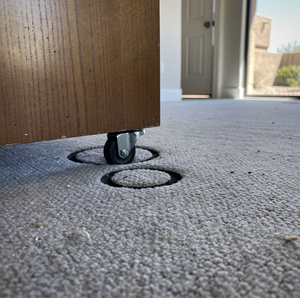
You are standing in the doorway with a tape measure, and across the room the piano has pressed two dark rings into the carpet where its front casters sit. Several hundred pounds have been resting on four contact patches you could cover with a thumb, and it has done so for years.
The first half of your question has a short answer. A piano goes to a crew that moves pianos, working from a board, straps, and a dolly rated for the load. The mass is not the problem. The distribution is. Where the weight sits inside the case, and how little those wheels will carry across anything but a flat floor, are what put this job past four willing friends.
Where a Piano Keeps Its Weight
An upright's strings run vertically, and so does the cast-iron plate they are anchored to. That plate fills the back plane of the case, from just above the keybed to the top lid, and it is heavy because more than two hundred strings pull against it. The pinblock sits at the top behind the tuning pins, and the keys and action you can see in front of it account for only a small fraction of the plate's weight.
So, on a vertical, 48-inch-tall stand, the bulk of what you are moving sits in the upper back of the case, well above the casters holding it up. That mass starts to matter the moment the instrument leaves the floor it has been parked on.
A grand carries the same problem differently. The whole assembly stands on three legs bolted into plates on the underside of the rim, and those legs are joinery. They take vertical loads well and sideways loads poorly, which is why your grand comes apart during a move. Steinway's Model D concert grand measures 8 feet 11 and three-quarter inches long and 61 and a quarter inches wide, standing on three points.
What the Casters Under It Will Carry
Those casters are furniture hardware. They will take the instrument a few inches off the wall and back on a hard, level, uninterrupted floor, and that is the whole of what they will carry. The rings in your carpet are what several hundred pounds, distributed over four small wheels, does to a surface, and on a wood floor, the same load takes the finish.
Roll a piano any real distance and a wheel eventually meets a lip: a threshold at your room door, or the bound edge of a rug. The wheel stops. The piano keeps going. Everything that was pressing straight down through the caster stem arrives sideways, and the stem shears or the leg it is set into splits along the grain. Even the double casters under a concert grand carry the load only on a flat stage floor, and only for a few feet.
Tipping an upright back onto two casters to clear a threshold places its load beyond the rear footprint, and the instrument can tip onto whoever is steadying it. Lift the top lid to see where that weight sits.
The Board, the Straps, and the Dolly
Your upright is lifted onto a four-wheel piano dolly rather than rolled onto it, set square, and strapped through the case with padding where the strap turns a corner. From there, the wheels doing the work are the dolly's, sized for the load and running on bearings, and your piano's own casters are off the ground.
A grand is stripped in your living room before it travels. The pedal lyre is unbolted, lowered onto its long, straight side on a padded piano board, and the legs come off once the rim is supported. The board is a heavy skid with slots cut for straps, and once the piano is cinched to it, the crew handles the board. At the far end, the sequence runs backward, and the straps stay on until the legs are back in their plates and the instrument is standing on them in your new room.
That is why the instrument is strapped down instead of carried. Hands change grip, and they change it without warning halfway through a turn. A piano fixed to a board cannot shift relative to what people are holding, and it can be set down anywhere on the route. Protecting a delicate finish in transit is a handling problem in itself.
Is the Path the Problem, or the Weight?
The weight is a fixed number you can look up before anyone arrives. The path is where a move is won or lost, because it changes whether the load stays under control between the room and the truck.
Work the route in your head in the order the piano meets it. The threshold at the room door comes first, then the hallway, where a radiator narrows it, then the turn at the bottom of the stairs, where the instrument has to swing through an arc that a doorway measurement does not capture.
Stairs are the sharpest version. Going down, the instrument is held back the whole way by people below it, and nobody can change grip or footing mid-flight. If a step on your route has no place to pause and no way to hold, the path has answered the question for you, whatever the number on the scale says.
What the Move Asks of the Instrument
The truck ride is the part you are probably picturing. Strapped to a board and restrained against a wall, a piano takes road vibration without much complaint.
The change that moves the pitch is the room. A soundboard is a thin panel of wood held under a slight upward crown, and it takes up and releases moisture with the surrounding air. The drier it gets, the flatter that crown sits and the less it presses against the bridges and the strings, and that pressure is part of what holds the pitch where it is. Put it in a house with different air, and the pitch moves with the wood. Your new room will also sound different for reasons unrelated to the piano, starting with the soft furnishings in it.
No one honest will promise you that the instrument sounds the way it did. What a careful move buys you is that any change you hear came from the room rather than from something that happened on a stair.
What a Crew Establishes Before Anything Moves
There is no piano-specialist credential for you to look up. Whether a household-goods mover must be licensed or registered where you live varies by jurisdiction, and that question is for your local regulator. Ask a crew to name their kit: a piano board, a four-wheeled piano dolly, ramps, and the path a grand's legs and lyre take while the rim is strapped down. Ask what their coverage does if the case is damaged in their hands. A company that moves pianos answers both without pausing.
The stronger signal is the questions coming back at you. A crew walks the route in both directions before anything is lifted, asking what the floor between the truck and the room will take from a loaded dolly, and where a landing exists wide enough to set the board down. Only then is the sequence worked out: which end leads, who stands where on a stair, and what comes off the instrument first.
That walk happens before a caster leaves your carpet, and it is the part of the job you should expect to watch. It finishes at the truck, where the liftgate carries a rating label giving the pounds it will lift, and the piano, the board, and the dolly all count against that number.
Frequently Asked Questions
Yamaha publishes 503 pounds for its 48-inch U1, a studio upright near the top of the vertical range and short of a full upright. A spinet, the shortest style at roughly 36 to 40 inches, comes in lighter, and a taller full upright is heavier again. Give your crew the make, model, and height rather than an estimate, because two instruments that fit the same corner can need different numbers of hands.
A few inches on a hard, flat, level floor is the limit of what those wheels will carry, and even that leaves marks on your floor. Caster cups, the hard dishes sold to sit under each wheel, spread the load over a wider area and stop a wheel pressing into your carpet pile or a soft finish. Anything with a threshold or a rug edge in it is no longer a rolling job.
Yes, and onto its bass side, the long straight edge, because that is the only part of the rim with a flat bearing surface along its length; the treble side is the curved bend and would carry everything on a short arc. Your pedal lyre comes off before anything tips, since it hangs below the keybed and would be first to meet the board, so expect to see it unbolted in your room.
On a straight run, planks are laid over the nosings of your stair so the treads become one continuous slope and the load rolls instead of stepping down tread by tread. The crew below holds it back on straps while the crew above keeps it from getting ahead of them. Winders, a landing that forces a turn, or an open side with a low rail change that, and those sections get done in short controlled holds.
The Piano Technicians Guild lists 68 degrees Fahrenheit and 42 percent relative humidity as the conditions in which a piano works best, and an unconditioned garage or a hot storage unit is nowhere near either. The glue joints in the soundboard and the pinblock pay for a big swing. Ask where a company actually holds your instrument.
After it lands, with a gap. The soundboard and pinblock take up and give off moisture until they are in balance with the air in the new room, and the pitch follows. Book the tuning two to four weeks out, so the technician can set the strings against the conditions your piano has settled into rather than the ones it is still leaving. A tuning done in the old house is set to the old house.
The route gets walked before the piano moves — doorway widths, the stair count, the turns and the surface in between are what a crew needs to size the job. Miranda Delivery Service serves the Phoenix metro. Call (480) 389-5928.