
How to Deliver Fine Art, Mirrors, and Antiques Intact
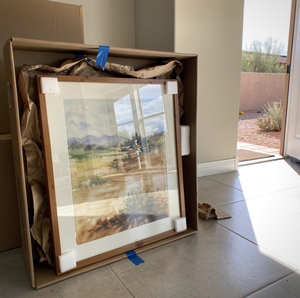
A sofa absorbs a bump. The frame flexes, the foam takes the hit, and a scuff in the upholstery stays a scuff. Framed art, mirrors, and antique case pieces have none of that give. They are rigid, so force put into one corner runs straight through to the weakest point instead of spreading out. They are brittle, so that point gives way all at once instead of deforming. And nearly all of their worth sits on a surface nothing is supposed to touch: a paint layer, a silvered back, a two-hundred-year-old finish.
The practices that make ordinary furniture delivery safe are only a starting point here. Each of these three classes fails in its own way, and each asks something different of the crew moving it.
Quick Answer: Rigid, brittle pieces fail differently from furniture. Framed art is endangered by its own glazing, mirrors by flexing across the plane of the glass, and antiques by old glue, veneer, and finishes that react to wrap and tape badly.
Framed Art and the Glazing in Front of It
The sheet of glass in front of a picture is the heaviest component of the assembly, the most breakable, and the one that does the damage. When glass fails in transit, the shards stay trapped inside the rabbet of the frame and slide against the artwork for the rest of the trip. A long score across a watercolor or a torn corner on a print is usually worse than the broken sheet that caused it.
That is why the glazing choice matters before anything is wrapped. Glass is heavier, so there is more inertia behind every stop and start, and it breaks into blades. Acrylic weighs far less and produces no cutting shards, which is why it is standard on oversized pieces. It has two costs: it scratches from grit that glass would shrug off, and it holds a static charge, which makes it the wrong choice in front of loose or powdery media such as pastel, charcoal, or a paint layer that is already flaking; the charge can lift particles off the surface and hold them against the inside of the sheet.
The frame is a set of miter joints held by splines, glue, and sometimes a nail. Corners are where a dropped piece lands and also the weakest joint, which is why corner protection is the first rigid layer to go on rather than the last. The top rail of an old frame is a joint under tension, and picture wire was designed for a static load, so a large framed piece has no convenient place for one person to hold. Ask a crew how they intend to support it.
The back matters too: A thin backing board flexes and pushes on whatever sits in front of it; a rigid backer keeps that flex out of the artwork.
Mirrors and the Plane of the Glass
A large mirror is a single thin sheet with almost no depth, and its strength runs in one direction. In the plane of the glass it is stiff; across that plane it is weak. Carried flat, the sheet sags under its own weight and gives way in tension along the face of the bend, which is how a big mirror breaks in the middle with nothing touching it. Stood on edge, the load runs the way the sheet is stiff, and it barely deflects. That property is why mirrors ride vertically, never flat on a deck, and never under a stack.
Flexing is also cumulative. A harmless input on one road adds up across hundreds of cycles and finds whatever flaw is already in the sheet. A chip in the edge looks like cosmetic damage and works as a crack origin, so an experienced crew reads the perimeter of a mirror before it looks at the face. On a frameless mirror with a beveled edge, the outside of the sheet is also its thinnest part, which makes edge protection the highest-value padding on the piece.
Silvering is the other reason edges rule everything. The reflective coating sits on the back of the glass under a protective backing, exposed only at the perimeter. Moisture that reaches a raw or chipped edge wicks between glass and coating, and the coating darkens inward in a cloudy border that does not clean off. A mirror sealed in film and left that way, moisture trapped against the edge, is one ordinary way that starts.
A full-length or oversized mirror poses a real laceration and crush risk. Glass that fails while being held opens along the carry line, so large mirrors and heavily framed pieces require a two-person crew wearing cut-resistant gloves and moving slowly.
Antiques, Old Joinery, and Finishes That React
Old furniture was assembled with hide glue, chosen because it is reversible: warmth and moisture soften it, allowing a restorer to open a joint without destroying it. That reversibility is also the risk in a hot vehicle, where a joint already loose can creep under sustained warmth and load. Loose joinery also changes what a piece can be picked up by. Arms, crest rails, and the top of a chest were never made to take the weight of the piece, so an antique with any movement in its joints is one to point out to the crew rather than lift yourself.
Veneer brings its own weakness. A thin decorative layer over a substrate is held by a glue line that has moved with the seasons for a century, and it lifts first at edges and corners. Strap pressure across a veneered panel, or tape pulled off one, takes veneer with it.
Old finishes react to what touches them. Shellac and old lacquer stay soluble after they cure, so alcohol, common cleaners, and the plasticizers in some plastic films soften them. Stretch film pressed onto an old finish can imprint its own texture at the contact points, which is why blanket wrap goes against the piece first and film only goes over the pad. Tape lands on the pad or the film, never on finish, veneer, or gilding. Gilded and gessoed ornament is fragile enough that a crew grips the structure, never a carved element; repairing a damaged surface is the conservator's responsibility.
What Each Packing Layer Does
A good package is a stack of layers, each with one job; the order matters more than the total thickness.
Barrier layer: Glassine, acid-free tissue, or a soft nonwoven goes against the surface. Its only job is to keep anything abrasive or chemically active off the piece; it adds no cushioning.
Cushion: Foam, bubble, or a moving pad lowers peak force by stretching a shock over more time. It only works while it still has room to compress, so a layer already flattened by a heavy frame passes the shock straight through.
Rigid layer: Corner blocks, edge protectors, a stiff backer, and a face panel turn point loads into spread loads, keeping anything from poking through the soft layers.
Outer shell: A mirror carton, a telescoping box, or a built crate keeps other freight, hand trucks, and forklift contact off the piece. The point of a purpose-built crate is that the piece never touches it: blocking or suspension holds it away from the walls so the crate takes the hits.
Face taping adds no strength to glass. What it adds is containment, so a sheet that does break stays in one piece instead of raking across the art or a forearm.
Once a piece is wrapped, nobody can tell the face from the back or the top from the bottom, so the outside of the wrap gets an up arrow and a note naming the art side.
Orientation and Restraint in the Truck
All of that padding can be undone by a bad load, and the truck is where the piece spends the most time. Glass, mirrors, and framed art ride vertically, on a padded rail rather than the bare deck, leaning against a padded wall rather than against each other.
Restraint has to bear on structure. A strap over the frame or the crate carries load through parts built to carry it; a strap tightened across a glazed face or a veneered panel presses on the fragile part. Nothing leans on the face of a mirror, or a picture, and nothing stacks on top of one, because a piece with weight resting against it is flexed for the entire trip.
Restraint applies on the short legs too: braking is the largest single force in a delivery day, and a piece left loose for a five-minute run has the whole deck to accelerate across. Continuous vibration is the quieter version of the same problem: it finds an existing crack, and anything free to shift wears through its own padding. Drawers and doors get secured so they cannot swing open at a stop, with ties over the pad rather than tape on the finish, and marble or glass tops come off and travel on edge.
Getting a Piece to the Wall Without a Surprise
The last few feet are where most surprises live, and nearly all come from an expectation nobody said out loud. A crew walks the route from the truck to the room before the piece comes off, because a large frame has to clear a stair turn on its diagonal.
Placement and hanging are separate jobs: Many delivery crews will carry a piece in, unwrap it, and set it in position where it is going. Driving hardware into a wall is a different undertaking, and it belongs in the conversation before the delivery date rather than at the door.
Settle any wall hanging before the delivery date: who supplies hardware rated for the real weight of the piece, and who is responsible for fasteners in framing nobody on the crew built. A failed hanging puts the piece on the floor.
Make a written condition record on both ends: Before the piece is wrapped, photograph every face, all four corners, and the edges, and write down what is already there: a chip, a veneer lift, craquelure in the paint, a soft spot in the silvering. After delivery, take the same photographs with the crew still present. The comparison answers when a mark appeared, and that record is what an insurer and a carrier both work from; what a policy pays for is a question for the insurer.
Unwrap and look at the piece while the crew is still there. Once the truck has pulled away, the timing of any damage becomes unanswerable.
Frequently Asked Questions
An unframed painting has no glazing between the paint and the world, so protection has to hover rather than touch: a rigid face barrier held off the surface on spacers, or a travel frame around the stretcher. The bigger hazard is pressure from behind, which presses the fabric against the inner edges of the stretcher bars and leaves permanent lines in the paint on the front.
Not long. Bubble wrap left with the bubbles facing a soft or aged finish can emboss a field of circles into it, and any wrap that stays on holds humidity against the surface. A wrapped piece propped in a hallway is also where most post-delivery damage happens, because it reads as packaging.
A dresser mirror mounted on a harp or support arms comes off at the mounting bolts and travels separately. The arms act as a lever: every load input into the case is multiplied at the top and delivered into the glass, and the mounting holes gather that stress at points in the sheet.
Anything loose inside a piece becomes a hammer. Removable glass shelves come out and get packed as glass, and loose finials, keys, and candle arms are bagged. Ask the crew or a clock specialist about the pendulum, the weights, and immobilizing the movement before moving an antique clock at all. Drawer contents come out too, since unsecured weight sliding inside a case can loosen joints nobody touched.
Stability matters more than any particular setting: wood and paper move with every swing in humidity, and the repeated cycling is what opens joints and buckles panels. Pieces should sit on dunnage off the floor and away from exterior walls, covered with something breathable rather than sealed in plastic.
Ask how many times the piece will change hands. A shipment that rides with the same crew from pickup to placement is handled a handful of times; one that moves through a terminal and gets cross-loaded onto a second truck is handled far more often, and every transfer is a new set of hands and a new load plan. It is also worth asking whether the piece travels alongside general freight.
Get a handling plan for the piece before it moves — from crating and load orientation to who is responsible at the wall. Miranda Delivery Service serves the Phoenix metro. Call (480) 389-5928.