
How to Pack and Move a Flat-Screen TV Without Cracking It
The set comes off the wall, is laid across the back seat with a blanket under it, and rides for 20 minutes to the new house. It goes up the next morning, powers on, and a dark blotch sits an inch off center that nobody remembers putting there.
What Actually Breaks Inside a Flat Panel
A flat panel is strong in one direction and weak in the other. Load it along its own plane, edge to edge, and it holds. Press on the middle of the face, or twist one corner against the opposite one, and the same glass goes into bending. Bending puts one surface of the sheet in tension, and glass fails in tension, starting at whatever microscopic surface flaw sits where the stress is highest.
An LCD set has two thin glass substrates with the liquid crystal layer between them, a stack of optical films in front, and a backlight assembly behind. An OLED panel is even thinner and less tolerant of bending. Either way, the fracture sits between layers you cannot reach, so it does not look like broken glass. Nothing shatters, and there is often nothing to feel with a fingertip.
What you see once the set is powered is a black blotch spreading out from the point that was pressed, a group of colored vertical or horizontal lines, or a fine spider running off one corner where fluid has moved into the fracture.
A second failure mode is not a crack. The driver chips feeding the panel's rows and columns are bonded along its edges on a flexible film; if the film flexes across that edge, a bond lifts, and one lifted bond can take out a whole band of the picture.
None of it announces itself: a set can take a bad load, look perfect, and fail at the first switch-on.
Why the Panel Rides on Edge and Never Flat
Set a television face-up, and the panel is supported only at its perimeter, by the frame, with nothing under the middle. Its own weight then acts perpendicular to the face, the one direction the sheet cannot carry, and the center deflects. Sitting still, that deflection is small. In a moving vehicle it is not: every seam and pothole sends an impulse through the deck, and the panel answers each one by flexing and returning, hundreds of times over a short drive.
Stand the same set on edge, and the weight runs down through the frame and through the glass in its own plane. That is the loading the assembly was designed around, and it is how the set will sit on a wall for the next decade.
A flat-screen television travels standing up. Not flat on a back seat, not flat in a truck bed under boxes, not flat on a dolly. The usual workaround, that flat is fine if you pad underneath, does not hold. Padding is soft and uneven, so it does not hold the panel flat; the sheet still sags between the points that carry it, which is the bending the glass cannot take. A horizontal set also invites someone to set something on it.
Hands belong on the frame edges and on the back near the mounting bosses, which anchor into the chassis. A palm in the middle of the screen is a point load on the weakest axis of the assembly, and a one-handed carry by the top edge twists the panel across its diagonal.
Before It Comes off the Wall or Stand
Photograph the back while everything is still plugged in, once wide and once close, then label the cable ends with tape and a pen. Note which HDMI port carries audio return to a soundbar, since it is usually only one of several and sound is what comes back wrong after a move.
Know the mount type before anyone touches it: fixed, tilting, or full-motion. On most installations, the plate stays bolted to the wall, and the bracket arms or rails stay bolted to the television, and the two halves separate at their interface. The piece that travels with the set is the bracket half, and it protrudes, so it catches doorframes. Knowing which fasteners belong to which half also stops someone from loosening hardware that never needed to move.
Stand hardware is small and it is the part that disappears. Bag the screws as they come out, label the bag, and tape it to the back of the frame.
A wall-mounted set can release from its plate without warning, and the full weight comes down at once. Have a second person holding the frame and taking the weight before anything is loosened, and clear the floor underneath first.
A large panel is a two-person lift, and not because of weight. It is awkward, the grip points are far apart, and the failure is almost always a drop while turning through a doorway rather than a strain while lifting.
The Original Box Is the Best Case, and Why
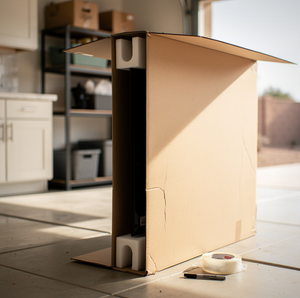
The factory carton solves the problem properly. Molded end caps grip the frame at the two ends and hold the set standing; the face touches nothing, and every handling load reaching the panel arrives through the frame. That is the design goal, and it is why a set that travels in its own box arrives intact far more often than one that is hand-wrapped.
When the box is gone, the substitute has to reproduce three things: the set held on edge, the face untouched, and the corners protected.
A purpose-made television carton is the closest match, sold as double-wall telescoping halves sized by screen diagonal so the depth adjusts to the set. Corner protection goes on next, because the corners are where an impact enters the frame and where the frame hands it to the glass. Then a rigid face guard: hardboard, thin plywood, or rigid foam board cut to the outside of the frame so it bridges edge to edge and rests on the frame rather than the glass.
Blankets come last, outside all of it. Blankets first is the common mistake and a real one. A compressible layer against the face does not hold the panel flat, which is what the glass needs from whatever it rests against.
What Should Never Touch the Screen
Shrink wrap and tape pulled against the screen do two kinds of harm. The front of the panel carries an anti-glare or anti-reflective treatment, and the polarizer film sits at the top of the stack, both softer than the glass beneath. Adhesive bonds to those layers and takes some of them away when it is pulled off, leaving a mark that no cleaning removes. Shrink wrap adds pressure over the middle of the panel as it tightens, the exact load it cannot carry, and in a warm vehicle it can adhere to the coating and leave a permanent haze.
Newspaper against the panel is the other habit worth breaking. Ink transfers into a matte anti-glare coating and stays there, and paper carries enough grit to scratch a soft coating when it slides under pressure.
If something must sit against the screen, use the protective sheet the set shipped with or a clean, lint-free cloth, and place every other layer outside it. Nothing wet goes near the face: a dry microfiber cloth is the whole toolkit.
Loading and Securing It for the Drive
The set rides upright, with its entire face backed by a flat, vertical surface: a cargo wall, a bulkhead, or the back of a folded seat. Backed matters as much as upright, because a free-standing panel can rotate, and a rotating panel is being twisted.
Strap it across the frame, over the packaging, anchored at two points, tight enough that it cannot tip, slide, or turn. Not tighter. A ratchet strap pulled down over a bare panel is its own hazard; flat webbing over a rigid face guard puts the tension into the frame. Put a folded blanket under the bottom edge so the frame is not sitting hard on a steel floor, where road input arrives with the least cushioning.
Nothing leans against it, and nothing stacks on it. And it never goes in the footwell, where a set sits at an angle, holds itself with nothing, and takes a knee or a shifting bag into the face when the vehicle stops hard.
Arrival: Upright, Warm, and Checked Before Anyone Leaves
Keep it upright and boxed until it goes on the wall or the stand. Out of its packaging, it stands on a soft surface with its back to a flat wall, floor in front kept clear, because a leaned television is a target for whatever else gets set down in the room.
Temperature is the step people skip. Liquid crystal thickens as it cools and the layers around it stiffen, so a cold panel responds slowly and can look dim or smeared; consumer manuals commonly give an operating range starting near 41 degrees Fahrenheit. Powering a very cold set is where a second class of damage occurs: the backlight and driver boards heat their part of the stack while the rest remains cold, causing the assembly to expand unevenly.
Condensation is the related risk. A set carried from a cold vehicle into a warm room is the coldest thing in that room, so moisture from the warm air collects on it, including on the boards behind the panel, and power across a damp board is what kills electronics. The answer is time, measured in hours, not a hair dryer or a heat gun aimed at the back: local heat drives moisture deeper and stresses the panel unevenly.
Leave a cold television inside its packaging while it warms up indoors. The carton slows the rate of temperature change, so moisture forms on the outside of the box rather than on the panel and the boards behind it.
Then test it before anyone leaves. A full-screen white image shows pressure marks and blotches a normal picture hides; a full-screen black image shows lines, dead bands, and backlight problems. Both take under a minute, and both are easier to run while the person who carried the set is still there.
What to Ask a Crew That Delivers or Mounts It
Three questions cover the part that matters. Who carries the risk for the panel while it is in the crew's hands, and what happens if the picture is wrong at power-on. Whether the crew mounts as well as delivers, since a delivery that ends with the television leaned against a wall leaves it in the one position where an ordinary knock finishes it. And whether the set is opened and powered on at the door, with you there, rather than after the truck pulls away.
Ask about the television specifically rather than the service tier in general.
Frequently Asked Questions
No. Cartons carry printed orientation arrows and an upward-facing side because the molded caps inside hold the panel by its two ends, keeping it standing. Laid flat, the set inside is in the same unsupported bending as a bare panel, with the added risk that a horizontal carton invites someone to stack on it. Factory shipments that do travel flat use full-face foam and a strapped pallet stack, which a car or a household truck does not reproduce.
Weight is not the number that decides it. A 55-inch class set without its stand commonly runs 25 to 40 pounds, and a 65-inch one 40 to 60 pounds, which one adult can lift off a table. Width is the problem: at roughly 48 inches across and up, one person cannot keep both hands on the frame and still control the far corner through a turn, and a turn is what every doorway asks for.
Yes. A flat rigid face guard laid across a curved panel touches the frame near the left and right edges and bridges a gap at the center, so pressure on the middle of that guard closes the gap and lands on the part of the screen that must never be loaded. Curved sets ship in foam shaped to the curve for that reason, and a generic television carton does not reproduce it.
It means the panel took a point load and the damage sits inside the glass stack, which is not repairable. The panel is replaced as a complete assembly, and on most sets that assembly is the large majority of what the television is worth. Physical damage is typically outside a manufacturer's warranty, so a claim runs through whoever was handling the set or through your own coverage, and those claims usually carry a short reporting window. Photograph the screen powered on and powered off before it moves again.
Yes. Feet or a pedestal left on the bottom edge stick out past the frame, become the first thing to catch a doorframe, and pass any knock straight into the panel's lower edge through the same threaded inserts that carry the entire set. Those inserts follow a VESA pattern, most often M4 on smaller panels and M6 or M8 on larger ones, and stand screws are frequently a different length from mount screws, so one set will not safely substitute for the other.
Not long in direct sun. Manuals commonly list a non-operating storage ceiling around 140 degrees Fahrenheit, and the interior of a parked vehicle in sun climbs well above outside air within the first half hour. The failure is not a crack: heat softens the optical adhesives that hold the film stack together, which can leave a mottled or clouded area that appears in bright scenes. Load the set last and take it off the vehicle first.
Ask how your television will be handled before it goes on the truck — get a straight answer on upright loading, mounting, and a powered-on check at the door. Miranda Delivery Service serves the Phoenix metro. Call (480) 389-5928.