
How Receiving Services Work When Your Freight Arrives Damaged
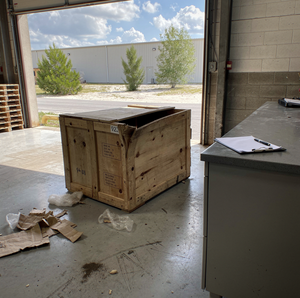
A crate comes off the truck with one corner staved in, and the driver is already reaching for the clipboard. What happens while the driver is still at the dock determines whether that damage becomes a paperwork problem for the receiving team to handle, or a surprise you discover in front of a client after the piece is already installed. Freight receiving exists to make sure it's the first one.
What Receiving Checks Before Anyone Signs
A signature at the dock is supposed to mean something. Before a receiving team signs for anything, they check the outside of the crate or carton for visible damage: crushed corners, torn shrink wrap, or a pallet that arrived leaning rather than square. That outside look happens at the dock, while the driver is still standing there, so any exception gets written down before he leaves.
Concealed damage is a separate problem: a carton can look untouched on the outside and still hold a case piece with a cracked leg or a mirror with a spider-cracked corner underneath the padding, which is why the crate gets opened at intake rather than left sealed until install day.
Writing the Damage on the Delivery Receipt
Seeing damage and recording it are two different things, and only one of them protects you later. The delivery receipt is the document a receiving team signs to acknowledge the freight arrived, and it has a line built specifically for exceptions: a written note of anything wrong with the shipment at the moment it's accepted, specific enough to match the item, such as "2 of 3 cartons, corner crushed" rather than a bare "subject to inspection." A crushed corner mentioned out loud to the driver, never written down, is a conversation nobody can point back to.
The receipt is the one document the driver and the receiving crew sign together, so a specific exception written there is the strongest record the claim will have; how the carrier weighs it is set by its own terms and the bill of lading.
Photos Fill in What a Written Note Can't
A line on a delivery receipt says damage exists. It doesn't show how bad it is, where exactly it sits on the piece, or whether it's cosmetic or structural. Photos taken at the dock, before the item moves an inch further into the warehouse, close that gap. The exterior packaging is photographed first, then the item itself once it's unboxed, so there's a visual record tied to the same delivery receipt the driver already signed.
This closes a gap for damage that reads differently in a photo than in a sentence. "Scuffed veneer" could mean a scratch that buffs out or a gouge that doesn't. A timestamped photo taken the day the crate arrived removes the guesswork and gives a vendor or a claims department the documentation a written note alone can't provide.
Deciding What Gets Refused, What Gets Accepted with Exceptions
Some damaged shipments are refused, and others are accepted with the damage noted. A receiving team weighs what's wrong against what the project needs. A shipment refused outright goes back on the truck, which is the right move when the damage is severe enough that the item is unusable, or when a full replacement is clearly coming regardless. A shipment accepted with a noted exception stays in the warehouse, with the damage noted on the receipt and recorded in photos, while the claim process runs separately in the background.
That second path exists because refusing every damaged shipment would mean redoing the freight leg for problems that don't require it, like a scuffed base under a top that will be swapped out anyway. Accepting with an exception keeps the project moving while still preserving the record that something arrived wrong.
Holding the Item While the Claim Works Through
Once a shipment is accepted with a noted exception, the item doesn't move again until someone decides what happens next. Part of that hold is a call to the carrier to report the damage and request an inspection, since the carrier's own terms typically set a window for that inspection, and missing it can weaken a claim before it's even filed. Until that inspection happens or the carrier waives it, the item sits in inventory, tagged to its project like anything else in the warehouse, but flagged separately so nobody schedules it for delivery by mistake, and re-packed in its original materials and left in place rather than moved around the floor. That hold matters because a carrier or vendor inspecting the claim needs the item available for inspection, and a piece that's already been delivered and unpacked in a client's home no longer has the same paper trail to point back to.
A claim can stretch a hold well past the original install date. Where summers bring extreme heat, that longer hold is a reason to confirm the held piece stays in a climate-controlled space the whole time and is never staged in an uncooled trailer or bay while waiting for the carrier's inspector; where summers are mild, the length of the hold matters less for heat-sensitive pieces.
Keep the crate, the blankets and every piece of packing from a damaged shipment until the carrier inspects it or waives inspection in writing. Carriers inspect the packing too, and a discarded crate is a gap in the claim.
Telling the Designer or Store Before the Item Moves Any Further
Whoever ordered the piece needs to hear about the damage before a decision gets made on their behalf, not after. The receiving team notifies the designer, store, or buyer promptly once the exception is noted, describing what's wrong, sharing the photos, and asking how they want to proceed: hold for a replacement, accept the piece as-is if the damage is cosmetic and acceptable for the room, or move straight into a claim. That notification is also where a realistic timeline gets set, since a replacement piece from a vendor follows its own production and shipping schedule, separate from the timeline the original order ran on.
Filing the Claim Under the Carrier's Terms
A freight claim runs on the terms set by the carrier and the bill of lading that shipped with the freight, not on a general rule of thumb. Those documents set out what constitutes a valid claim, what documentation is required, and how the process progresses from filing to resolution. A receiving team that's already photographed the damage and noted it on the delivery receipt at the moment of arrival has done the part of the claim that has to happen fast; the part that follows, working the paperwork against the carrier's own terms, is a separate step that takes longer and depends on the specific shipment.
Frequently Asked Questions
What does the receiving team record besides the damage itself?
Piece count and carton count go on the receipt alongside the damage note, because a shortage is a separate exception from damage: a shipment can arrive with four of five cartons and a crushed corner on one of them, and each problem needs its own line so the carrier isn't left guessing which issue a claim is about.
What happens to a damaged item once a claim is filed?
It stays put. Carriers can ask to inspect the item in person or request the damaged piece itself as salvage before a claim settles, so a warehouse holding it keeps the item on hand rather than disposing of it once photos are taken.
Should the damaged item be repaired before the claim settles?
No. A repair made before the carrier inspects, or waives inspection, changes the evidence, so the piece remains as it arrived until the carrier says otherwise.
What should you ask the carrier for once an inspection is scheduled?
A copy of the carrier's own inspection report. That document is the carrier's record of what its inspector found, separate from the receiving team's photos and receipt note; having both gives a claim two independent accounts of the same damage rather than one.
What should the damage photos capture besides the item itself?
The carrier's shipping labels and the bill of lading number, photographed alongside the damaged area. Without that, a photo shows damage but not which shipment it belongs to, and a claim built on unlabeled images gives a carrier nothing to tie back to its own paperwork.
Can a client reject a piece after it's already been signed for?
Once the driver has left, that's a decision the ordering party makes with the vendor or store, not a refusal to the carrier, since only the party at the dock can refuse a shipment to the carrier itself. A cosmetic issue found after signing gets handled as a return or exchange with the vendor, separate from any freight claim already filed over the same damage.
Route your project freight through a receiving dock that checks, photographs, and notes damage before signing — a crew that documents exceptions at the door and holds the piece until you decide on a claim or a replacement. Miranda Delivery Service serves the Phoenix metro. Call (480) 389-5928.