
Gallery Wall Installation: Plan the Layout Before You Hang It
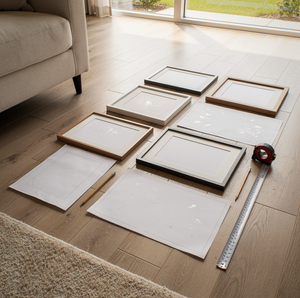
A gallery wall is decided on the floor and on paper before a single hole is drilled into the wall. Once the group is up, it reads as one shape: the outer edge of the whole arrangement and the gap held between frames carry the layout more than any single piece does. A hole placed in the wrong spot stays in the wall behind the patch and the paint. Working out the full arrangement first is what keeps that from happening on the piece that matters. The table pairs each planning decision with what it settles for the installer.
| Planning Decision | What It Settles for the Installer |
|---|---|
| The wall and what sits in front of it | Whether furniture, a headboard, or a walkway sets the height and side clearance the layout works around |
| The group's outer shape (grid or mixed) | Whether the frames line up on a shared edge or are arranged around a center point |
| The anchor piece | Which frame the rest of the group is measured from |
| Spacing between frames | The visual gap held from piece to piece across the whole group |
| The center line of the group | The height the whole arrangement is built around, not any one frame |
| What's inside the wall (studs, outlets, switches) | Where a fastener can go and where it can't |
| Weight and hanging hardware on the back of each piece | What kind of fastener each spot in the layout needs |
Choosing the Wall and Reading What Sits Below It
The wall itself is the first decision, and what sits in front of it shapes the layout along with the wall's own size.
A wall behind furniture: a gallery wall centered above a sofa or a headboard reads against that piece rather than against the room, so the arrangement's width and lower edge are measured from the furniture below rather than from the wall's corners.
A wall along a walkway: a hallway or stairway wall has nobody sitting in front of it, so the group can run the length of the wall instead of centering on one piece. The lower edge still has a job here: it has to clear anyone walking past without a frame corner catching a shoulder or a bag.
Laying the Arrangement Out on the Floor and Transferring It to the Wall
Laying the group out on the floor first, in the same footprint the wall will occupy, turns a stack of frames into an arrangement. Moving a frame on the floor costs nothing; moving it after a hole is already in the wall does not. Photographing the floor layout from directly above once it's settled provides a record to check the wall against as pieces go up.
Paper templates carry that floor layout onto the wall without a single frame touching plaster before its spot is confirmed. Cut a template to the outer size of each frame, tape it to the wall in the position the floor layout sets, and mark on the template where the hanger sits on the back of that piece. Once every template is taped up and the whole arrangement is confirmed against the wall, the fastener goes through the mark on the paper, not through a frame held up and eyeballed.
Grid or Mixed Arrangement and What Each Asks of the Measuring
A grid arrangement lines frames up in even rows and columns, all the same size or a repeating size, with the same gap held between every neighbor. That consistency is also what a grid demands of the measuring: the same spacing gets checked and rechecked at every join, because a grid shows a small error more than a mixed arrangement does. One frame set slightly off throws off every frame that lines up with it.
A mixed arrangement uses different sizes and orientations, so it depends on visual balance around the anchor piece and the group's center line rather than on a repeated measurement. The gap between frames remains consistent, but the arrangement is checked by eye against the floor layout rather than by rechecking a spacing figure at every join.
Keeping the Spacing Consistent and the Group's Center Where You Want It
Spacing is both a visual and a measured decision: the eye judges each gap against its neighbors across the whole group, so one gap set wide stands out in the finished wall. A single spacer, cut once and moved from gap to gap, maintains the same distance across the whole group without a fresh measurement at every join, and it stays consistent in a way that measuring each gap by hand, one at a time, does not.
The group's center line is a separate decision from any single frame's height: it's the height the whole arrangement is built around, and it gets set before the first template goes on the wall, not adjusted afterward by eye. A group centered on a piece of furniture below carries its center line at a set relationship to that furniture, not to the wall as a whole; a group on an open wall carries a center line set to a comfortable eye level for the room, independent of the wall's own dimensions.
What the Installer Needs on the Day
An installer arriving to a settled plan works differently than one arriving to a stack of frames and a general idea. The difference comes from the final layout, confirmed and templated on the wall rather than described out loud; a clear answer on which piece is the anchor, since the rest of the group is measured from it; and every frame arriving with its hanging hardware still attached rather than loose in a bag, so the installer isn't matching wire to frame to hanger on-site.
Getting a piece delivered and set in the room is a separate step from getting it hung on the wall, and this plan is what the hanging step runs on once the piece is on hand. A glass-fronted piece gets carried and handled at the edges, never by the glass itself, on its way to the wall.
Mirrors and Heavy Frames in the Group
A mirror or a heavy frame changes what the layout needs from the wall itself: the anchor and the fastener both have to accommodate the piece's actual weight, so the plan marks which templates belong to those pieces.
Heavy frames and mirrors need solid backing and hardware sized to the piece, so the installer handles that hanging, along with any ladder work over a sofa or headboard and any drilling near an outlet, where wiring can run behind the wall.
Frequently Asked Questions
Do all the frames in a gallery wall need to line up along the same top edge?
No. Two different conventions handle frames of different heights: aligning every piece along a shared top edge keeps the upper line of the group clean even when the frames below vary in height, while aligning on a shared center height keeps the midpoint of each frame level instead. Picking one convention and holding it for the whole group is what keeps the wall from reading as random.
What happens to the layout if the wall has a seam, a chair rail, or wainscoting running through it?
A horizontal seam or a strip of trim becomes a fixed line the layout has to respect rather than cross. The bottom row of the arrangement is built up from that line rather than from a floating center, since a frame that straddles the seam reads as a mistake even when its measurements are otherwise correct.
Can a spot be left open in the layout for a piece that hasn't arrived yet?
Yes. Marking a gap in the floor layout and leaving its template off the wall holds that spot in the plan without forcing the rest of the group to be re-measured once the missing piece arrives. The center line and the anchor piece stay the same; only the one template gets added later.
Should the largest frame always go in the middle of the group?
Size alone doesn't decide it. A large frame in a pale mat and a thin border can read as lighter than a small piece in a dark, heavy frame, so the anchor is chosen by that visual weight rather than by which piece is physically largest. A heavy-looking piece anchored off to one side can pull the whole arrangement's balance with it.
How does a wire hanger on the back of a frame change where the template gets marked?
A wire hanger sits under tension between two points, so its peak, the spot a nail goes under, hangs lower than the frame's own top edge once weight is on it. A sawtooth hanger sits at the frame's top edge, and a D-ring sits wherever it is fastened on the back, so each is marked on the template at its own position, measured down from the top edge.
What if a template goes up crooked or a gap looks off once everything is taped to the wall?
Because each frame's spot is held by its own taped template rather than by a frame already on the wall, one template can be pulled and repositioned without disturbing its neighbors.
Reserve mirror and art installation — the crew hangs each piece from your templated layout, level and securely fastened to the wall behind it. Miranda Delivery Service serves the Phoenix metro. Call (480) 389-5928.